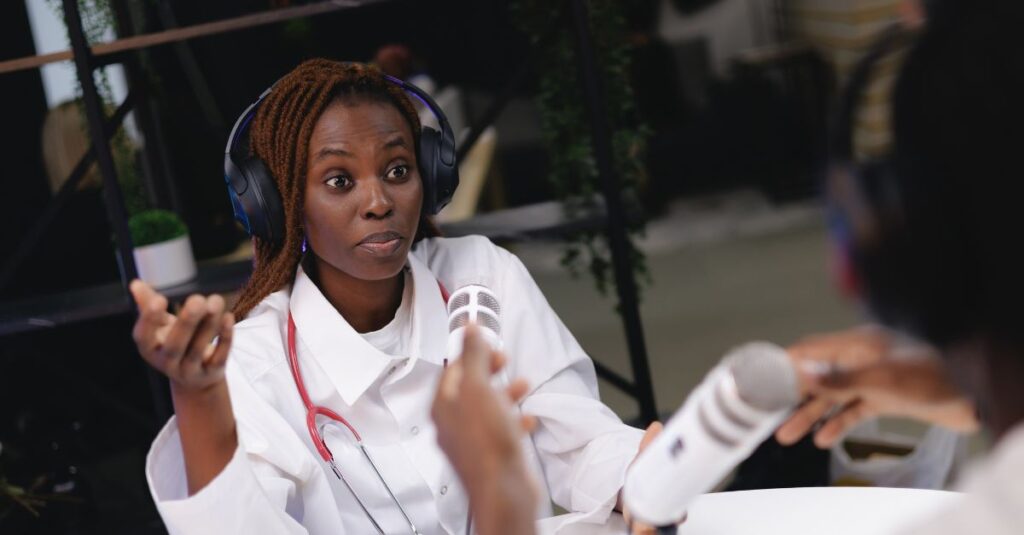
Say “influencer” to a room of doctors and someone will roll their eyes. The word still carries the smell of discount codes and teeth-whitening kits. Yet the audience those doctors belong to has quietly become one of the most influencer-shaped in professional life, with one difference that changes everything: the creators they actually listen to hold a licence to practise.
Marketing decks have started attaching a number to this. Clinicians, the claim goes, trust licensed creators three times more than other sources of medical content.
The multiplier may be tidy. The pattern underneath it is real, and better evidenced.
Peers First, Platforms Second
Healthcare professionals were on social media long before pharma worked out what to do about it. Industry survey work collated by the Digital Health Coalition found that 72 per cent of HCPs follow other HCPs on social platforms, and that nearly half of physicians check social channels several times a day. What they follow matters more than where. A Wiley survey of clinician behaviour found HCPs are three times more likely to notice an advertisement when it appears in a source they already trust, and that more than half consult two or more sources before letting an insight anywhere near a clinical decision.
That is the shape of professional trust: it travels along credentials and proximity, and only afterwards along reach. Edelman’s health trust research points the same way, finding trust concentrating in the nearest, most personal sources, with doctors trusted at around 85 per cent while institutions drift downwards.
Why should a licence matter so much on a platform where anyone can sound authoritative? Because it is a verification shortcut. A registered doctor, nurse or pharmacist who posts nonsense answers to a regulator, an employer and a professional community that knows where they work. The audience understands, without thinking about it, that a licensed creator has something to lose. An anonymous wellness account does not. Trust, in this reading, is less a feeling than a calculation about accountability, and clinicians make that calculation faster than most because they live inside the system that enforces it.
The industry has even given these people a name. Julie Granberry, EVP of strategic growth at Relevate Health, describes it plainly: “We’re seeing the rise of the DOL — the Digital Opinion Leader.” These are clinicians building followings among their peers, doing informally what key opinion leaders have long done from conference podiums.
The pattern extends well past professional audiences. Analysis compiled by Health Union found that TikTok users had spent more than 630 million hours watching videos involving doctors, with nurses, pharmacists and physician assistants all among the platform’s most-watched professions. The lanyard, it turns out, is a format in its own right.
A Licence Cuts Both Ways
For pharmaceutical and health brands, the temptation is obvious. Partner with the trusted messenger and borrow the trust.
It is not that simple, and the reasons are the same ones that make licensed creators credible in the first place. The PMCPA’s revised social media guidance, published in early 2026, treats influencer arrangements as consultancy arrangements under the ABPI Code, with written agreements, unambiguous disclosure and active monitoring of the creator’s account for the life of the contract. A vague “#ad” does not satisfy the disclosure requirement. And the clinician carries their own exposure: professional regulators expect registered practitioners to uphold standards in public statements wherever they make them, which is precisely why their word is worth something.
The homework is unglamorous. Verifying registration status, checking specialty against subject matter, and agreeing in advance who screens the comments, since a sponsored clinician’s post attracts patient replies, and patient replies can contain reportable safety information.
There is a subtler risk too. Trust built on independence is spent by association. A licensed creator whose feed becomes indistinguishable from a brand channel stops being the thing the brand paid for. The partnerships that work tend to be the restrained ones, where the clinician’s editorial judgement visibly survives the contract.
How solid is the evidence base under all this? Honest answer: softer than the decks suggest. Trust is self-reported, survey samples skew towards the digitally active, and a multiplier measured in one specialty on one platform rarely holds across another. Anyone quoting a single tidy figure is compressing a messy picture.
What does not seem soft is the direction. Clinicians increasingly get their professional signal from other clinicians on open platforms, and audiences of every kind are learning to check for the lanyard before they believe the post.
Which brings back the eye-roll in that room of doctors. They are right to distrust the word influencer. They always were. But the people changing how medicine talks to itself are not the ones the word conjures. They are colleagues with a registration number, a following and, so far, the benefit of the doubt.